Mirroring 2001: A Space Odyssey, Barbie arrives like an alien monolith, a new technology, a promethean fire. A cherubesque young girl is possessed with the spirit of innovation, and reenacts the hominid of 2001: A Space Odyssey who for the first time takes grip of a bone and wields it as weapon in the birth of tool making. Our golden daughter takes hold of her baby doll, introduced as the only type of doll yet available to youths, and a tiring one at that. “Ask any mother,” insists the narrator, implying the given, motherhood sucks ass. Our angelic daughter, our innocent sister, the primitive impressionable inner child of the feminine raises her own infant above her head and crashes it down upon the baby dolls scattered all around her. The babies crash and shatter and explode and the trajectory of a primitive impressionable womanhood is forever altered. Barbie has liberated women from motherhood.
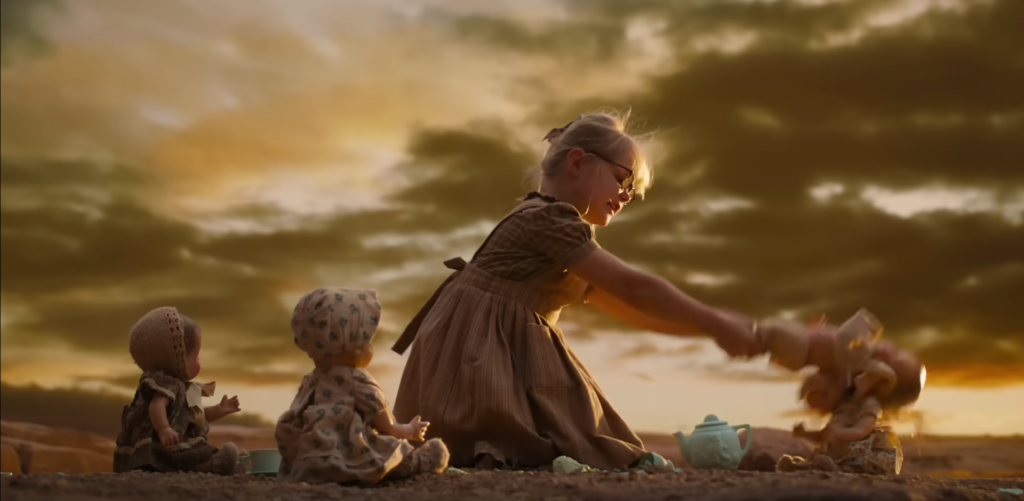
Its not surprising that a middle aged mother becomes the motivating force of the plot upon the simple market logic that the demographic most familiar with Barbie and its cultural consequence are now aged, though apparently still grappling with post-Barbie psychological stress. Barbie, the film, implies that the generative spark which evolved a femur in to a satellite, a baby doll in to a pioneering femme of epic proportions, is an active force in the psyches of women and even young girls today.
Barbie is a psychedelic fever dream with a paralleling-universe aspect, otherworldly physics and moments of fourth wall penetrations. Much discourse surrounding the film regards the optics of bodies and lifestyle or the films soap box messaging, though these appear to be only tools for the tinkering and toying around of the more mercurial subconscious aspects. The platitudinous girl boss rhetoric serves more as setting than theme, being so common place now that it is assumed, a grounding principle in our present.
On some “as above, so below” shit, the classic Barbie doll residing in her unchanging perfect plastic world of idyllic forms (with the exception of comic relief Barbie-doll character Midge, the pregnant doll discomforting any character that encounters her) begins to experience new unsettling sensations. As our Barbie’s characteristic tip-toe feet, always formed for a high heel, fall flat to the earth, she begins also to suffer intrusive thoughts of death. Her psyche is linked to a girl who is playing with her in the real world. A rift between the coexisting worlds somehow results and our Barbie is tasked with an inter-dimensional travel to find and correct what is ailing her mind.
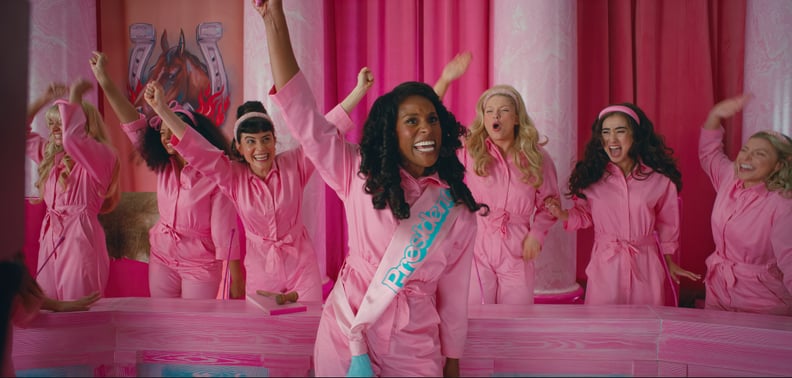
Leaving behind a black woman president, all woman construction crews, an all women Supreme Court, even women novelists, Barbie arrives in the real world with stow-away Ken, a man-doll existing only as accessory to Barbie and without defined goals or purpose other than seeking the attention and love of Barbie, a writers room’s clever reversal of gender roles. Quickly this new world unveils its politics and social order as Barbie is introduced to the inherent violence of the male gaze and Ken gets his first taste of recognition and empowerment, patriarchy. Wasting little time Barbie locates her target at a high school where she is woke-scolded, belittled and mocked by the Latinx femme teen she thought to be her psychic counterpart. Some shit happens and we learn that the Latina mother (side note: yt cuckold beta husband) has been playing with our Barbie, works as a high level receptionist at the company producing Barbie (and in actuality the film, Barbie), Mattel, and is a little messed up in the head, illustrating Full Body Cellulite Barbie and Intrusive Thoughts of Death Barbie among others at her desk during work hours.
Mattel’s all male upper management is informed of the escape of their patented dolls in to the real world, then effortlessly capture Barbie, planning to place her back in “the box”. The head of Mattel is played by Will Ferrel and thereby the character is made to be an idiot and so follows his staff. Tropes of sexism and exaggerated misunderstandings of the contexts of gender and race deliver some laughs here. Ken, fueled by new self confidence and an expedient mission to obtain understanding of this world through book learning sets back to Barbie-land the way he came after being dismissed as laughably harmless by the Mattel men, a writers room’s clever reversal of gender roles. Barbie escapes the box, is pursued in a comical chase scene and with unexpected aid and harboring from her Latinx girlies, makes a clean get away. Here the films complicated psychology begins to exposit as the two hidden yet connected worlds begin to overlay.
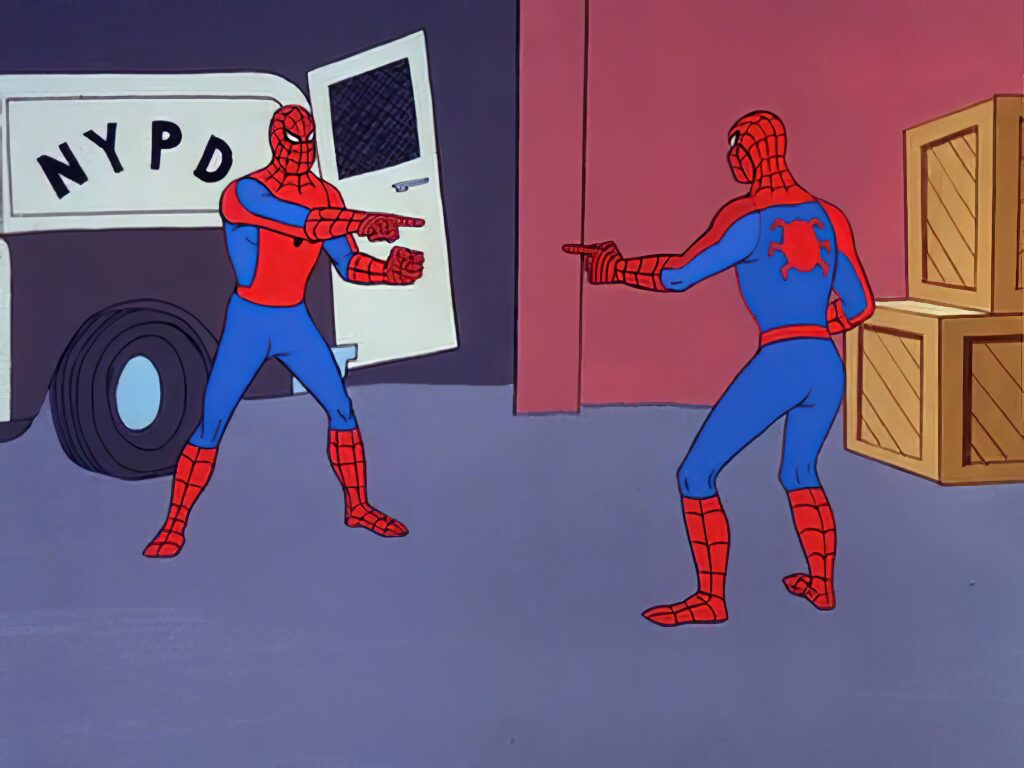
The real world is bad because patriarchy. The Barbie world is good because matriarchy. The Barbie world is bad because unrealistic beauty standards. The Barbie world is good because women empowerment. The Barbie world is bad because it was created by men. The real world is good because Latinx leading roles. The real world is bad because unrealistic standards for women because Barbie is bad. The real world is good because realistic depictions of mental illness. The real world is bad because mental illness. Barbie is good because liberation from motherhood. Barbie is bad because motherhood and aging unrepresented. Beneath the plastic feel-good empowerment storyline lies a metaphysics felt and manifested as the unease in both the mother character and consequently her projected Barbie. Our Barbie character is an apparition of a narcissist’s subconscious shadow, dragged in to sight to be incorporated in to the ego of the mother on her archetypal journey. Though, does any of this analytical psychology work involve the petty contradictions of ideological difference between the two worlds? More will be revealed.
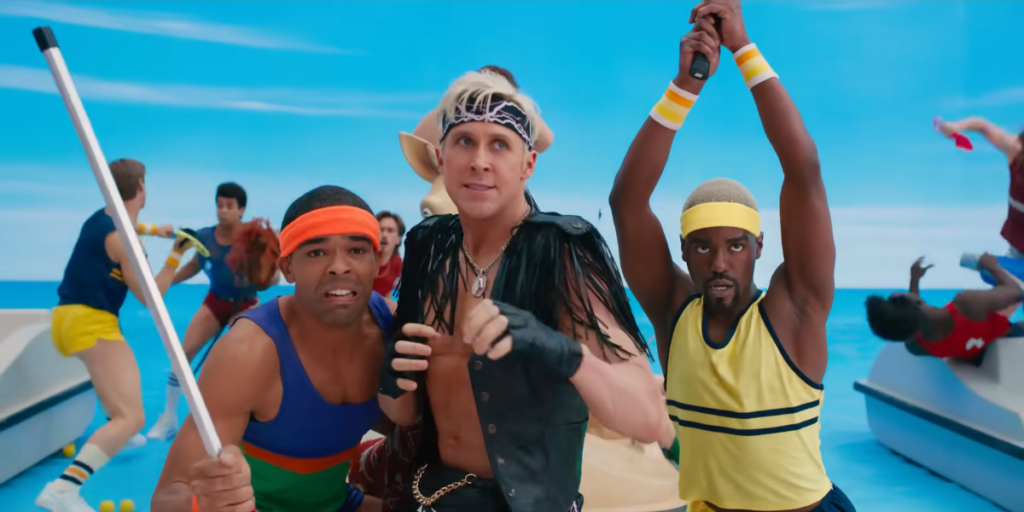
Ken has brought Patriarchy to Barbie-world. The man-dolls have taken on all labor, leaving behind the running-gag ambiguous job of “beach”, relieving the Barbie dolls to tasks of the home, care taking and charm. In what seems a measure of a single day, Ken’s coup has converted the entire Barbie world. The Barbie dolls extol the new system where even the black woman president has stepped down to enjoy a simpler life of passing out “brewski beers” to the fellas. The bumbling idiot Ken has somehow masterminded an entire revolution, or perhaps patriarchy is its own alien monolith sentient viral technology requiring only a carrier. To this epidemic of dudes’ rule return our horrified leading ladies.
In a moment of intense frustration, Mother unleashes a torrent of struggle session grievance, a run-on regarding the ways in which womanhood has been made near impossible to bear. The avalanche of modern feminist talking points, including the expectation to be skinny but not too skinny and to fuck but not be easy and to have charisma but always be sympathetic to the egos of men or something, shakes a nearby Barbie-doll free of patriarchy’s mind trap, returning her to girl boss mode. With this discovery the girls set out to undo Ken’s widespread “brainwash” by KIDNAPPING WOMEN IN TO A VAN AND EXPOSING THEM TO A REHEARSED PROLONGED RHETORICAL DEVICE, deprogramming them. With the feminine minds back in their correct Barbie-world social-political alignment a counter insurgency is quickly organized to destabilize the Ken ranks. Deploying advanced hyper-educated feminist skill, the Barbie insurrection sets in motion a plan to make the Kens jealous by flirting with other Kens, activating a violent animal impulse that immediately dissolves the organization of the patriarchy and allowing the Barbie dolls to reinstate their positions of power.
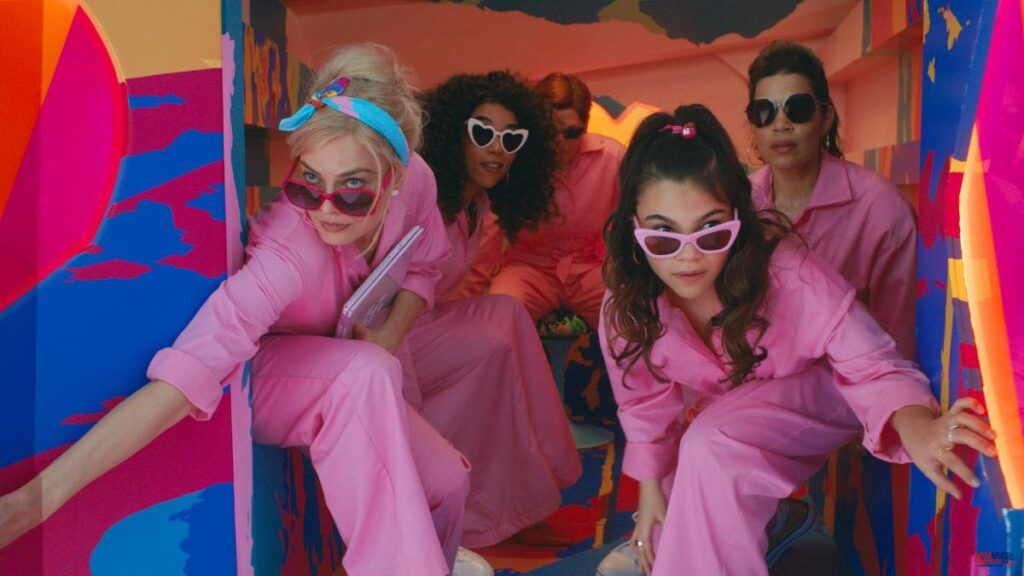
Will Ferrell and the Mattel men show up in Barbie-world after all this to return the real-world people to their home and repair the universal rift or something. They are the men in power after all. At this face-to-face encounter with the patriarchy, her employer, mommy airs her grievance once more, finally requesting the production of a Barbie doll representing a completely average middle aged woman who is a little fucked up in the head.
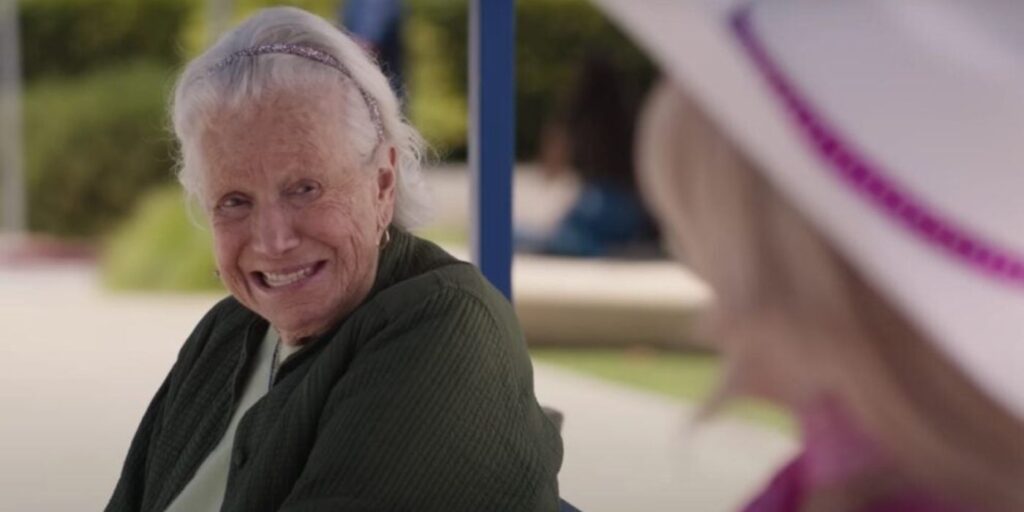
Amid this showdown, our aged mother faces her culturally distant daughter in a mask-off moment for the film. It is relevant to note that after Barbie is initially rejected at the high school, she sulks to a nearby bus stop and first experiences crying before turning to find an old old lady awaiting the bus. Barbie stares at the blanched wrinkled woman then extends to her the she is “beautiful”. “I know it,” replies the woman. Director Greta Gerwig reportedly refused to cut this scene, claiming it to be the “heart of the movie”. The momma takes the daughters hands in hers, probably, and confers to her child in a moment of clarity, a mother stands still so that her children can look back and see how far they’ve gone. However clunky regarding self awareness, this moment shows a first step towards displacing her ego from the center of her perception of her worth. Barbie is about the egos of narcissistic aging women.
To the request for an average woman Barbie, Will Ferrell agonizes, saying it is a terrible idea. A Mattel man of the upper ranks chimes in, “It would make a lot of money,” and Ferrell quickly O.K.’s the project. Barbie, the movie, is this requested product. Mattel has heard the demands of the exhausted masses, and though it is a terrible idea, it has made a lot of money. With this admission the movie admits a conclusion has been made by allowing a character to interrupt, asking if there’s also an ending, a conclusion to the psycho-spiritual question, for Barbie the doll.
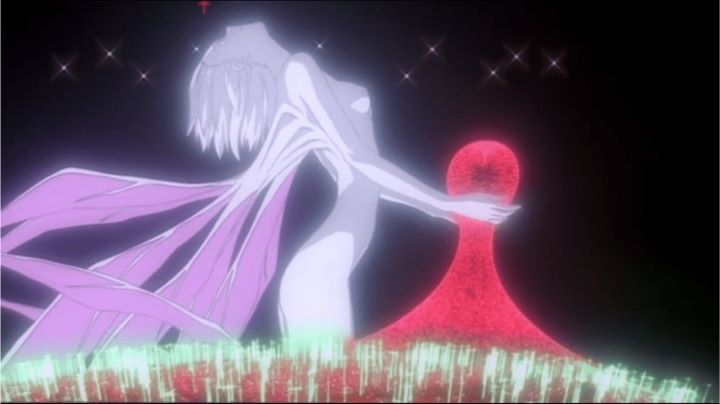
Already appearing less plastic and more relaxed with something effortless about her hair and flowing in her dress, Barbie is led off stage by the ghost of Ruth Handler, creator of the Barbie doll, in to a void space empty of plot, characters and setting, similar to Shinji’s instrumentality moment at Neon Genesis Evangelion’s original series close. As Barbie confronts her future now tainted by attrition, decay and death, opposing her identification with youth, beauty and capability, she exposes the simple and main distress in the psyche of the mother character who is the physiological carrier to Barbie’s psychological being. To the contorted soul of beauty torn from timeless pantheon, the mystical specter offers a zen-like wisdom to Barbie’s existential crisis. In a free genie undoing of bondage, Barbie is unshackled from her quandary regarding what makes her herself if not her measure to perfection, released from the expectation of existing as a symbol, quieted in the cacophony of discourse regarding what a woman should do or be. In this moment of release Barbie is disentangled from the mothers ego, allowing mom access to aging with grace and wisdom relieved from the weight of narcissistic vanity, fulfilled as mother of child. Barbie closes her eyes and is instructed to just feel, and a montage of a variety of women captured on home video in sepia begins to reel. Who are these women? Well, the audience of course.
Baudrillard says, “Disneyland is presented as imaginary to make us believe the rest is real,” implying that in the same way we allow fantasy to construct the magical zone of Disneyland, we also construct every other part of the world. The Barbie-world and the real-world, with their contradictions and tensions are a unified samsara with a natural underlying current. The world of global-violent-pickup-truck-cowboy-male-gaze-brewski-beer and the counter positioned black-female-pink-White-House-independent-woman-in-back-breaking-labor are constructed like Baudrillard’s Disneyland earth. Barbie’s final conclusion invites the audience to reject the movie itself, to step out of the discourse, away from post-human logocentrism, in to the body and its intuitive wisdom.